Amazon.co.jpで買えます。
English version is on Page 2
Miscellaneous on Page 3

By John Everett
12/13/2014
In the 20th century there emerged a prolific religious leader named Reverend Sun Myung Moon who founded the Unification church in 1954. Over a lifetime of tireless and heartfelt service to others, he left behind a large corpus of religious teachings. As with many great leaders, he was often a subject of controversy during his life. His writings were said by Christians to be heretical, as they allegedly contradicted the teachings in the Bible; many people are afraid of change and will denounce something new. This paper will dissect Reverend Moon’s teachings in his book Exposition of the Divine Principle, especially the second chapter “The Human Fall,” and will determine whether or not these teachings are sound doctrine or are indeed heretical. And furthermore, what greater ramifications would such soundness or heresy imply?
Hello and welcome to 2015! My name is John and I will be your host for today’s article. Well, I took off November and December to focus on other projects, and I must say I haven’t made much progress in any of them except for the rest of the articles in January. So, hooray for me. Anyway, I think I’ll give you a personal update as I did for last year’s New Year article. So let’s have at it, shall we?
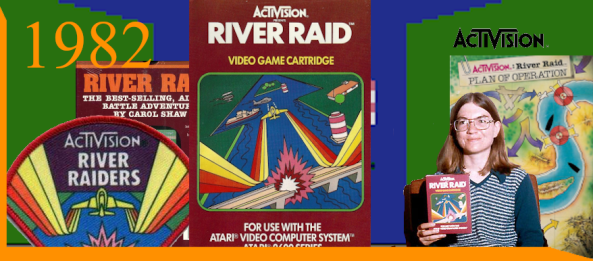
Original version: River Raid, released on 1982/08/19 for Atari VCS a.k.a. Atari 2600
Recommended version: River Raid, released in 1983 for Atari 800
Isn’t it amazing how war, the greatest misfortune, often provides the greatest backdrop for a story? Whether it’s an epic tale of a warrior’s fight as in The Iliad, or the slow torment of a man’s mind as in “Lawrence of Arabia,” war has a seemingly limitless capacity for showcasing the ultimate struggle in all its manifestations. It makes sense then that video games, tasking the player with overcoming a struggle, would be so well suited to war. What makes River Raid so special, though, is that it’s one of the first shooters to take place on a “realistic” depiction of Earth. The cover of the manual even appears to be alluding to the mountainous jungles of Viet Nam. So let’s go raid that river!
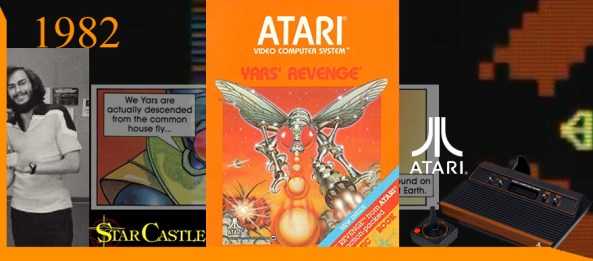
Original version: Yar’s Revenge, released on 1982/05 for Atari VCS
It’s funny how game consoles and computers carry different connotations with them. Even though consoles are just computers designed for a specific purpose, they carry a different association. Today, consoles are considered more “sociable” whereas PC gaming is often considered suitable for a “lone-wolf.” Multiplayer games on consoles are built with the living room in mind, and up until the seventh generation any game with a multiplayer mode included local multiplayer (i.e., the other players are sitting next to you instead of miles away) by default. In the 1970s and ’80s consoles also carried the connotation of shrinking down arcade cabinets to cartridges. Ever since the days of Home Pong consoles tried their hardest to bring arcade games to households.
This is an essay I wrote for my leadership class in the Corps of Cadets at Virginia Tech. I found it while organizing files on my external hard drive. With this glimpse into the past, you’ll get to see how far my writing ability has come since 2009.

30 inches per step, at 120 beats per minute? That’s far.

Original version: Ms. Pac-Man, released in 1982 for arcade
Welcome back to school, everyone! This was my research paper for last semester. In it, I detailed the causes of poverty and present a solution. I was researching this paper while debating Mr. S and what I found greatly helped in regards to this paper. If you find any errors, or have any feedback whatsoever, please leave a comment. Thank you.
John Everett
Dana Killmeyer
ENG 102-1045
05 May 2014
The Light at the End of the Tunnel: Is an End to Poverty Possible?
What if you were told that it’s possible to not just help the poor, but to eliminate poverty altogether? If so, how could this be done? The answers are much simpler than you think. No matter whether we look at poverty in a rich country like the United States or a comparatively poor country like China, underlying causes always remain the same. More amazingly, not only is this true for every country on Earth today, but for history as well. When all is said and done, the one common factor in poverty, no matter where or when you look, is excessive government intervention in the market. The solution to poverty, simply enough, is liberty. That’s it. There are no complicated mathematical formulas.
This was a diagnostic writing I did for my English composition class. I had one hour to complete it; this is the finished essay.
Margaret Mead said, “Never doubt that a small group of thoughtful citizens can change the world. Indeed, it is the only thing that ever has.” However, it is hard to believe that just a few people can make a significant difference. Given the many great challenges that the world faces, it seems impossible to change anything for the better unless one can attract a lot of people and spend a lot of money.
Assignment: Can a small group of concerned individuals have a significant impact on the world? Plan and write an essay in which you develop your point of view on this issue. Support your position with reasoning and examples taken from your reading, studies, experience, or observations.
Hello! While writing my second manga I wanted to make a record of the process so I could share with you. Now, I haven’t read a great deal of manga in my time nor did I read any tutorials or ask any artists. That, I think, goes a great way toward explaining how my first one turned out…. Anyway, let’s take a look at the process!
Page 1: Story of #1
Page 2: Drawing & Editing #1
Page 3: Concept of #2 and Storyboarding
Page 4: Drawings of #2
The first one started with a short story. Except for the image of Milo, I had no visuals in my head. Here is the original story:
 Cake's Corner